Description
Douglas Wilson / Copenhagen Game Collective · 2010
A digitally-mediated party game for two to eight players. Everyone takes a number of steps back from the screen, then races through physical space to reach the controllers. The screen states the goal — press your button in a particular way, or in some rounds defend your button from being pressed by others — and then gets out of the way.
The design move that matters is what the system refuses to do. B.U.T.T.O.N. cannot see the room. It does not know who pushed whom, who started early, or who is sitting on someone else’s controller, so it cannot enforce most of what it asks for. Wilson designs this deliberately, calling such systems “self-effacing games” and the goals they set “unachievements”. Cheating is not a failure of the design, it is the content: the players have to decide together what counts, and that negotiation is the game.
Wilson’s own framing of why this matters is the sentence closest to this research:
In drawing our attention not just to players, but also to the relationships between them, Eichberg and DeKoven offer us provocative new ways of thinking about game design.
video: B.U.T.T.O.N. (Brutally Unfair Tactics Totally OK Now) — Copenhagen Game Collective, YouTube
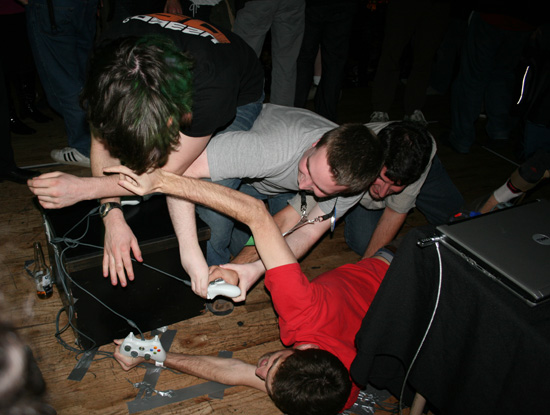
Wilson’s own caption: “The author, trampled playing B.U.T.T.O.N. at GAMMA IV”. The system sees none of this.
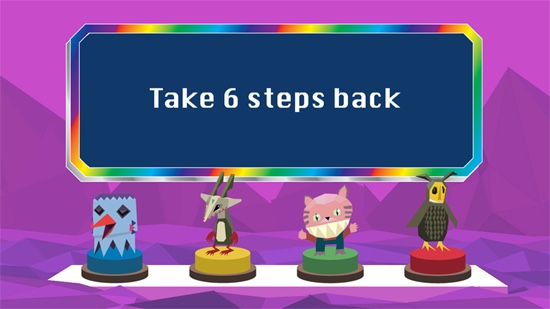
“In most rounds, the game instructs the players to take some variable number of steps away from their controllers” — and then has no way to check that they did.
images: figures 1–2 from Douglas Wilson, Game Studies 11(1), 2011; game by Copenhagen Game Collective