Description
Tim Murray-Browne & the Cave of Sounds collective · Music Hackspace, London
Cave of Sounds connects music’s prehistoric origins with the technological radicalism of the music hacker scene. Eight bespoke instruments are exhibited in a circle. They are there to be played by the audience in an unmediated collaborative exploration.
The eight instruments are arranged in a circle facing inwards. Each can be approached and played by audience members and any number can be played together. They are all designed to be played with no prior experience. Diverse methods and sounds emerge, with an equitable experience for participants that treats those with no musical experience the same as it treats those who are musically adept.
Each of these electronic instruments, which you can play with movement, light, shadow and touch, feeds into a centralised computer that keeps everything in key and on beat. In the centre, a glowing hub emits flickers of dancing lights in response to the musical activity, illustrating connections between the instruments and how participants can interact with each other through sound. Inspired by drumming circles and other non-hierarchical musical practices, this layout aims to encourage participants to look up beyond their own instrument and connect with those around them.
Some musicologists such as Christopher Small have argued that any musical ritual, from an orchestral recital to an illegal rave, serves to celebrate or reinforce a particular model of how society is sociopolitically organised. In this light, we challenge the specialisation of creative expression within contemporary society, and, for many, the relegation of artistic experience to passive consumption.
Earlier documentation of the prototype ensemble: The Cave of Sounds, 2013
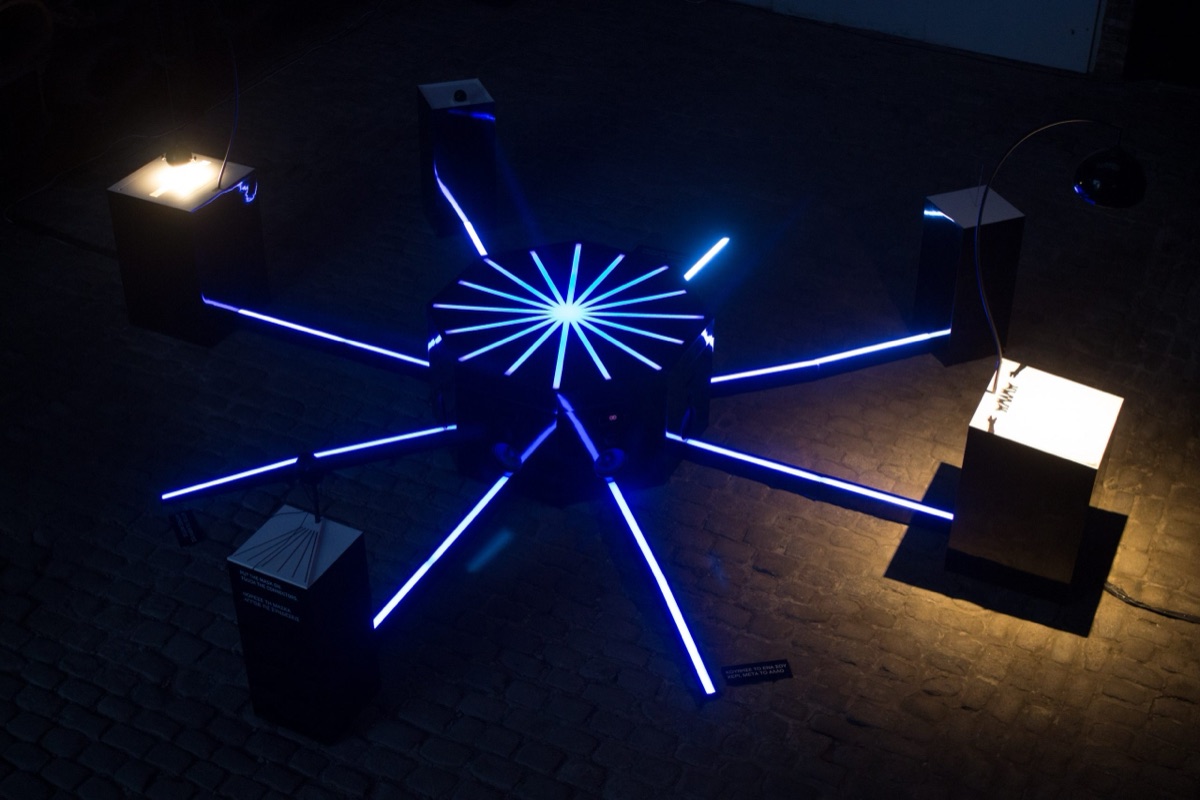
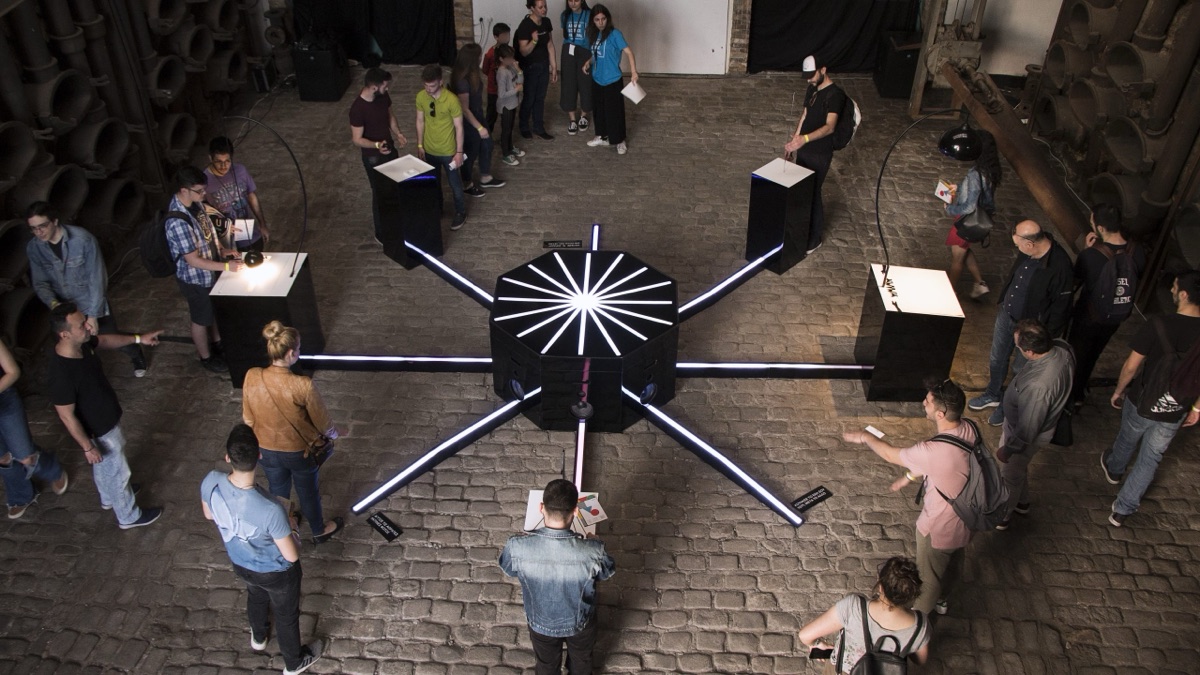
photos: Anastasia Alekseeva, Athens Science Festival, 2018
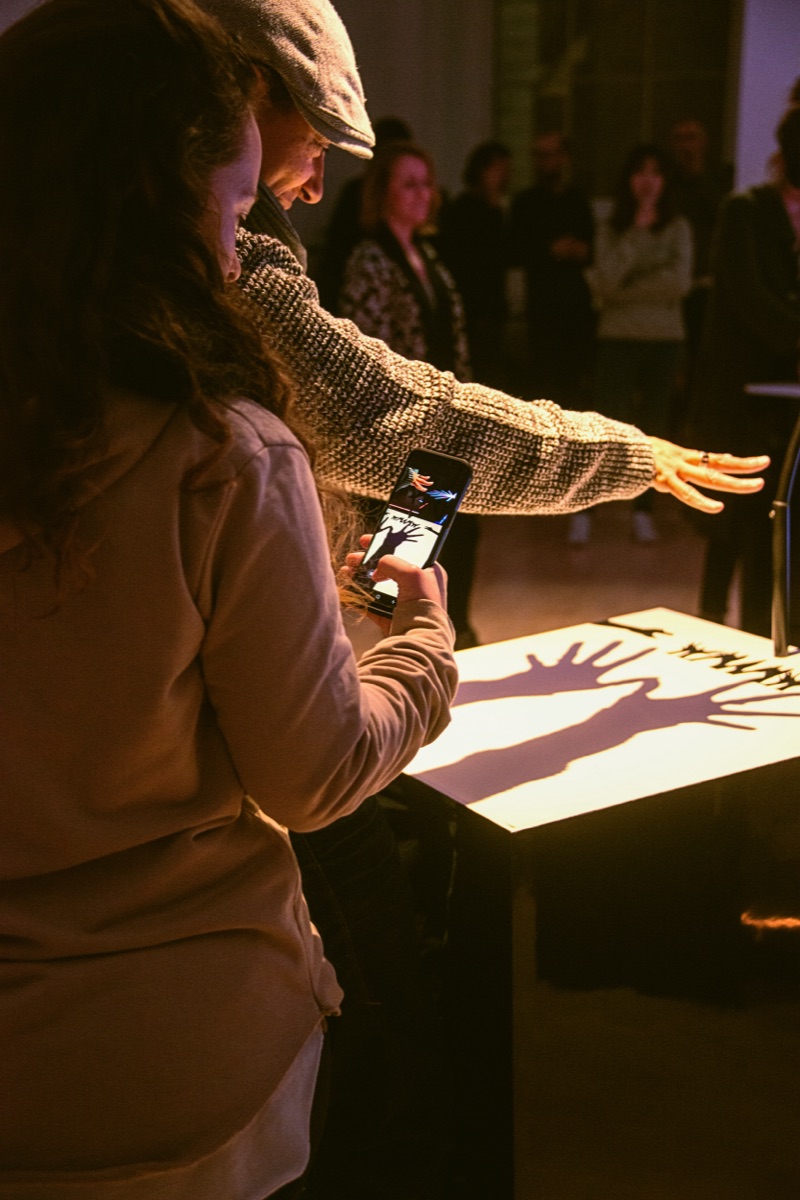
photo: Suzi Corker, Somerset House Studios, London, 2018
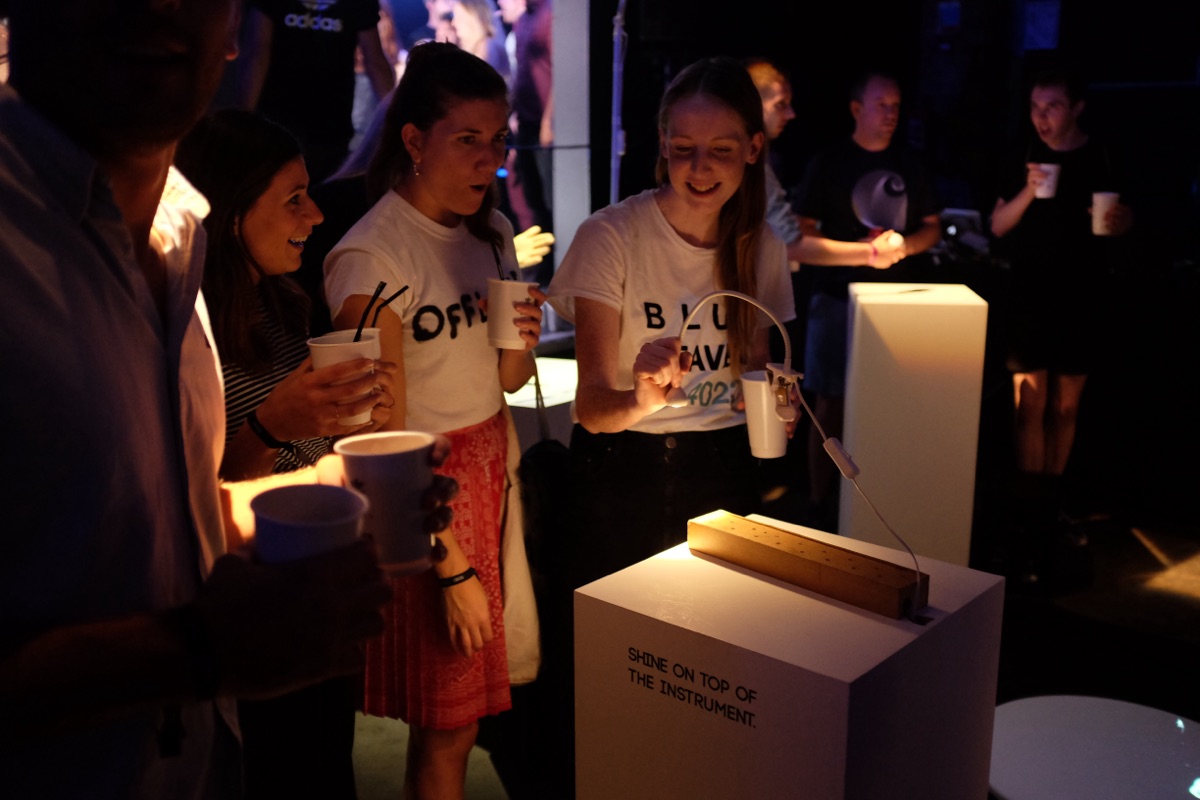
photo: Tim Murray-Browne, Village Underground, London, 2016
The eight instruments
Each artist in the collective built one instrument encapsulating their own identity and musical practice. Visitors interact with each one in a radically different way.
| Instrument | Artist | How you play it |
|---|---|---|
| Sonicsphere | Panagiotis Tigas | A palm-sized sphere with an embedded wireless gyroscope you use to warp spaces of heavy digital timbres |
| Joker | Wallace Hobbes | A drum kit you play by wearing a mask and tapping your fingers onto conductive tape |
| The Animal Kingdom | Daniel Lopez | Sounds you awaken by casting hand shadows in the shape of animals onto a table top, read by an interior camera |
| Generative Net Sampler | Tadeo Sendon | Samples made from field recordings of the internet, triggered as you move through invisible cylindrical zones |
| Lightefface | Kacper Ziemianin | A deep drone you control by shining lamps over 24 light sensors, each modulating one harmonic |
| Campanology | Dom Aversano | Rhythms derived from the mathematics of church bell ringing, controlled by free movement of the hands |
| Mini-Theremin | Susanna Garcia | A DIY theremin run through a pitch-tracker, turned into a controller for noise synthesis |
| Wind | Tim Murray-Browne | A breathy flute you play by moving your hands around your body through a grid of harmonious notes |
Process
Cave of Sounds began in November 2012 when Murray-Browne, composer in residence at Music Hackspace through Sound and Music’s Embedded programme, announced an open call to join an experimental collective of musicians. The group adopted an experimental process of group improvisation, “akin to a jam session stretched over many years” — meeting regularly to share ideas, experiment and listen, so that musical roles emerged organically without hierarchy or an authoritative vision. The prototypes toured for five years (Barbican, V&A, 90dB Sonic Arts Festival Rome, Village Underground) before a 2018 Arts Council England grant turned the work into a tourable installation. Nominated for the Ars Electronica STARTS Prize 2018.
images: Cave of Sounds, caveofsounds.com