Description
James Saunders · 2020–21
For large mixed ensemble, at least fifteen players, duration variable and ideally at least twenty minutes. Each player needs a pitched instrument and at least one everyday sound source — a cardboard coffee cup, a bowable object, polystyrene, paper, a harmonica in C, a whistle. Megaphones, roughly one per ten players, are placed around the room in advance. Players are dotted around the performance space rather than seated as a conventional ensemble, with similar instruments kept apart.
The score is a pool of a hundred numbered cues. A player calls a cue out loud — a number, or one of a set of cue words: START, END, FASTER, SLOWER, HIGH, MIDDLE, LOW, BACK, FORWARD, HOLD, WAIT, REPEAT, LOOP START, LOOP STOP, CONTINUE — loudly enough to reach some of the other players and the audience, and may pick up a megaphone to reach further. Anyone may answer a cue that somebody else has called. The asymmetry is written into the rules:
Players must respond to their own cues, but do not necessarily have to respond to cues given by others.
The piece begins when one player calls START; the others each decide for themselves what to play first, and need not begin together. It ends after an agreed duration, when one designated player calls END.
Saunders takes the title from Owen Jones’s The Establishment, and describes the piece as putting decision-making at “local levels of social organisation (individual players, immediate neighbours)” to see what priorities emerge from the group and how they shift.
Commissioned by Neue Musik für Alle e.V. with the Ernst von Siemens Music Foundation. First performed by KNM Campus Ensemble with CoMA ensembles from the Netherlands and the UK, Klangwerkstatt 2021, Haus Bethanien, Berlin, 14 November 2021.
source — the composer’s page for the work · scores, free to download
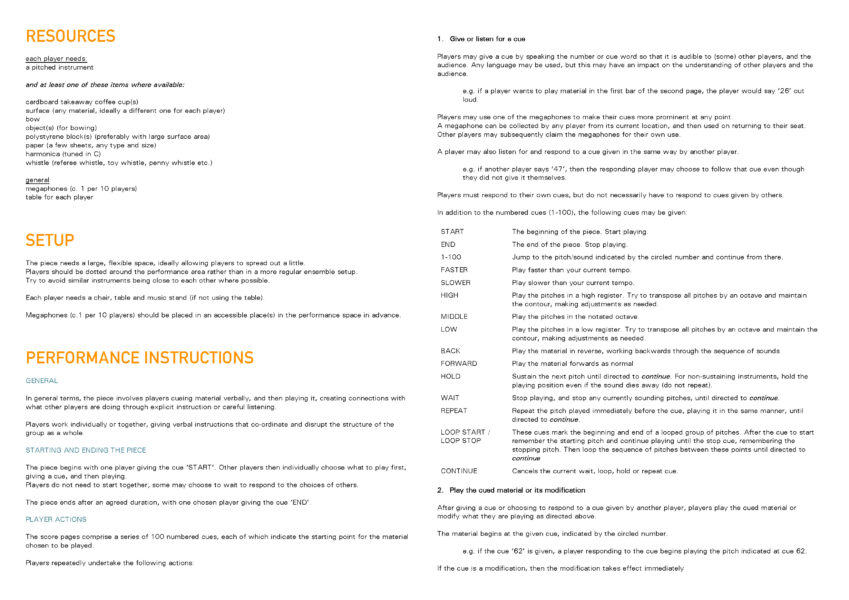
The performance instructions and the cue table — START, END, 1–100, FASTER, HOLD, WAIT, LOOP START — that players call out to each other.
image: score page, James Saunders, james-saunders.com