Description
Pin Chun Lu, Wen-Fan Wang, Che Wei Wang, Ting-Ying Lee, TsaiHsuan Lin, Duo-Jie Hsiao, CheHan Hsieh, YuTing Tseng, Neng-Hao Yu, Mike Y. Chen · National Taiwan University · CHI 2026 (Honorable Mention)
Two players in the same room, both wearing mixed-reality headsets, jointly operate one tracked physical prop — carrying, tilting and moving it together to play. The prop adds a shared physical communication channel on top of the visual and audio ones a co-op game normally has.
The paper’s starting complaint is worth quoting for this research: current co-op games keep collaboration virtual even when players are physically co-located in the same room. Two people sitting side by side still coordinate through the screen. Putting one object in both their hands moves the coordination back into the room.
They ran a workshop with ten professional designers to map the design space of physical co-op — prop and interaction patterns, and how those relate to affordance and cooperative experience — then a within-subjects study (n=16) comparing virtual against physical co-op. Physical co-op produced finer-grained task coordination, fewer collisions, and more strategy-focused communication, and players rated it higher for collaboration, sense of achievement, enjoyment and overall preference.
On scope. The headsets matter and should not be glossed over. Wearing one changes what bodily co-presence is: you cannot see your partner’s face, so the non-verbal channel this research is interested in is partly replaced rather than simply present. Cite it as evidence that a shared physical constraint changes coordination — not as a case of unmediated co-presence.
video: the paper’s accompanying project video — 李映萱, YouTube
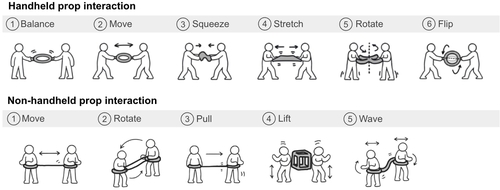
The vocabulary the workshop produced: six ways two people can act on a prop they are both holding, and five for a prop that connects them without being held.
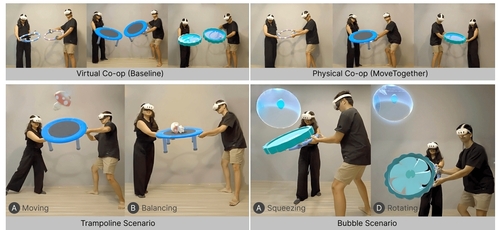
The two study scenarios, with the virtual-co-op baseline at top left for comparison.
images: Lu et al., MoveTogether: Exploring Physical Co-op Gameplay in Mixed-Reality, CHI 2026 (CC BY 4.0)